 ZenScapes Inc
Dry creek bed or French drain?
A dry creek bed carries water you can see running across the surface. A French drain collects water you can’t see, soaking through the soil. They solve different problems, and plenty of yards need both.
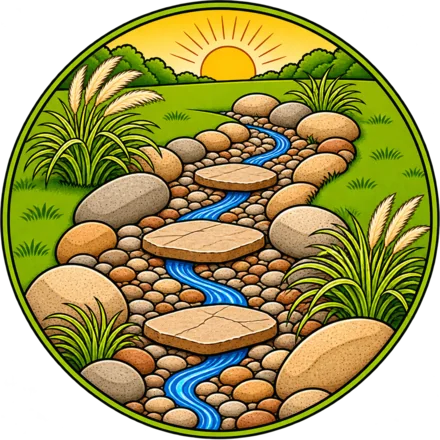
Side by side
| Compare | Dry creek bed | French drain |
|---|---|---|
| What it is | An open channel lined with river rock, built to look like a stream bed. | A buried trench of clean stone around a perforated pipe. |
| The water it handles | Runoff moving across the surface in a storm. | Water soaking through the soil, or a spot that stays soggy. |
| What it needs | A downhill path and somewhere to end. | A steady fall along the pipe and an outlet lower down. |
| What you see | A stone feature that can be planted along its edges. | Nothing, once the lawn grows back. |
| How it fails | Rock too small for the flow gets carried off. | No outlet, too little fall, or soil clogging the stone. |
What a dry creek bed needs
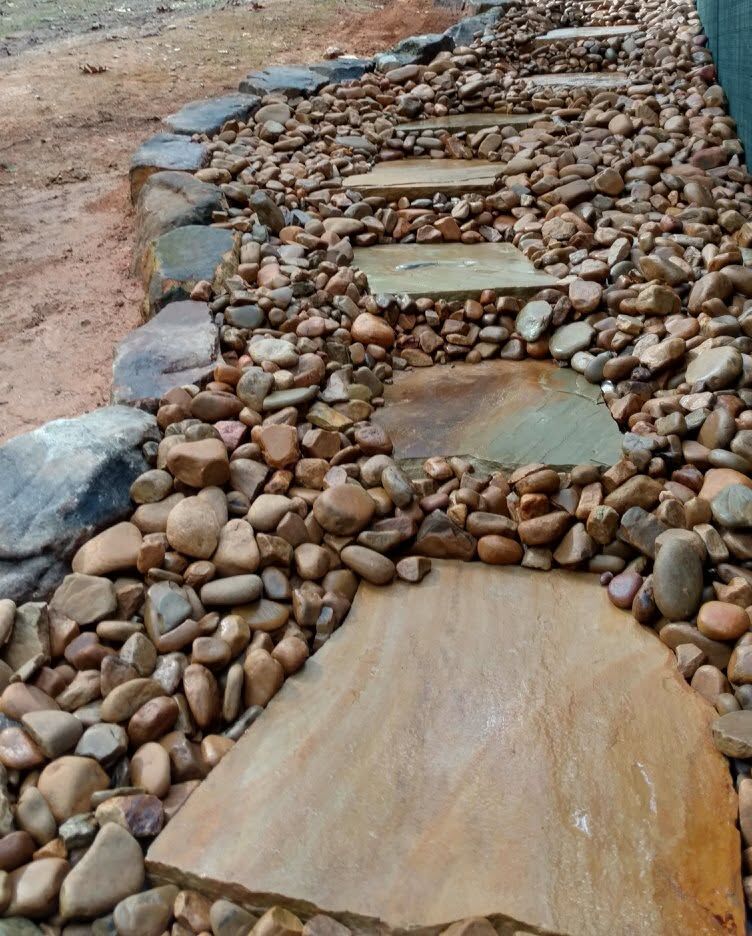
A dry creek bed is a channel lined with stone and shaped like a natural stream. It is dry most of the year and carries storm runoff when it rains. Its plainer cousin is the swale: a broad, shallow channel shaped into the ground and usually left in grass.
Either one only works on water that is already running on the surface, and needs enough slope to keep that water moving.
- A start and an end. It begins where the water gathers, often at a downspout or the foot of a slope, and ends at a lower spot that can take the water.
- Rock sized to the flow. Small rock in a strong flow gets carried downhill, so the heavier stone goes where the water pushes hardest.
- Room to spread. A wide, shallow channel slows water down. A narrow, deep one speeds it up.
What a French drain needs
A French drain is a trench with a perforated pipe at the bottom, filled with clean stone. Water in the surrounding soil finds the stone, drops into the pipe and runs out the far end. LSU’s extension service describes a trench 12 to 18 inches wide and 18 to 24 inches deep, with a 4-inch pipe covered in washed gravel.
- Fall. The pipe has to slope steadily toward its outlet. Clemson’s extension service says to hold a 1 percent slope, which is about an inch of drop for every eight feet. Colorado State gives 1 to 3 percent.
- An outlet. The pipe has to come out somewhere lower. A drain with no outlet is a buried puddle.
- Clean stone and fabric. The gravel is washed so it has no fine dust in it. Filter fabric laid in the trench and up its sides keeps the surrounding soil from washing in and clogging it.
Water moves slowly through tight red clay, so a French drain has to sit where the water is. That is why we find the source before we dig one.
When a yard needs both
A common case: water sheets down a slope in a storm, and the lawn at the bottom stays soft for a week. The creek bed takes the storm flow. The French drain dries out what soaks in. The pipe can let out into the creek bed, so the two share one way out.
Other fixes worth checking first
- Downspout extensions. If the water is coming off the roof, piping it away from the house may be the whole job.
- Regrading. A low spot with no way out is fixed by reshaping the ground, not by a drain.
- A catch basin. Where water collects at one point, a grated box and a solid pipe move it faster than a French drain can.
If you’re not sure what you have, start with standing water in the yard.
Sources: Clemson Home & Garden Information Center; LSU AgCenter; Colorado State University Extension; University of Arkansas Extension on dry stream beds; Alabama Extension on swales.
More guides
- Standing waterA simple test for a wet yard, where the water comes from, and which fix suits which cause.
- Stone names and sizesFieldstone, flagstone, boulders, river rock and base stone: what the yard names mean and the sizes each comes in.
- Plain-English glossaryBatter, course, crusher run, swale, surcharge and forty more trade words, explained in a sentence or two.