 ZenScapes Inc
Standing water in the yard after rain
North Georgia red clay soaks up water slowly, so a yard can stay wet for days after a storm. The fix depends on where the water is coming from, so start there.
A simple test
Dig a hole about 12 inches deep in the wet spot and fill it with water. If it empties within a few hours, the soil drains well. If water is still standing in it 24 hours later, the soil is packed down or heavy with clay.
That is the University of Georgia Extension’s test. Where a spot fails it, the water has to be carried off, because the ground won’t take it in fast enough.
Source: University of Georgia Extension, guide to healthy garden soil.
Where the water comes from
Go out in a hard rain with a raincoat and watch. Most wet yards have one or more of these:
- The roof. A downspout that empties at the foot of the wall puts a whole roof’s worth of water in one spot.
- The slope above. Water runs downhill across your yard, or onto it from higher ground.
- A low spot. A dip with no way out fills like a bowl.
- Packed soil. Clay pressed down by building work or traffic sheds water like pavement.
- Water in the ground. A spot that stays wet in dry weather may be a spring or a high water table, and needs a different fix.
Which fix suits which cause
Start with the fix that needs the least digging.
| Cause | Usual fix | How it works |
|---|---|---|
| Downspouts | Downspout extensions | A buried solid pipe carries roof water to a spot lower down, away from the house. |
| A dip with no way out | Regrading | The ground is reshaped so water has a path out and no place to sit. |
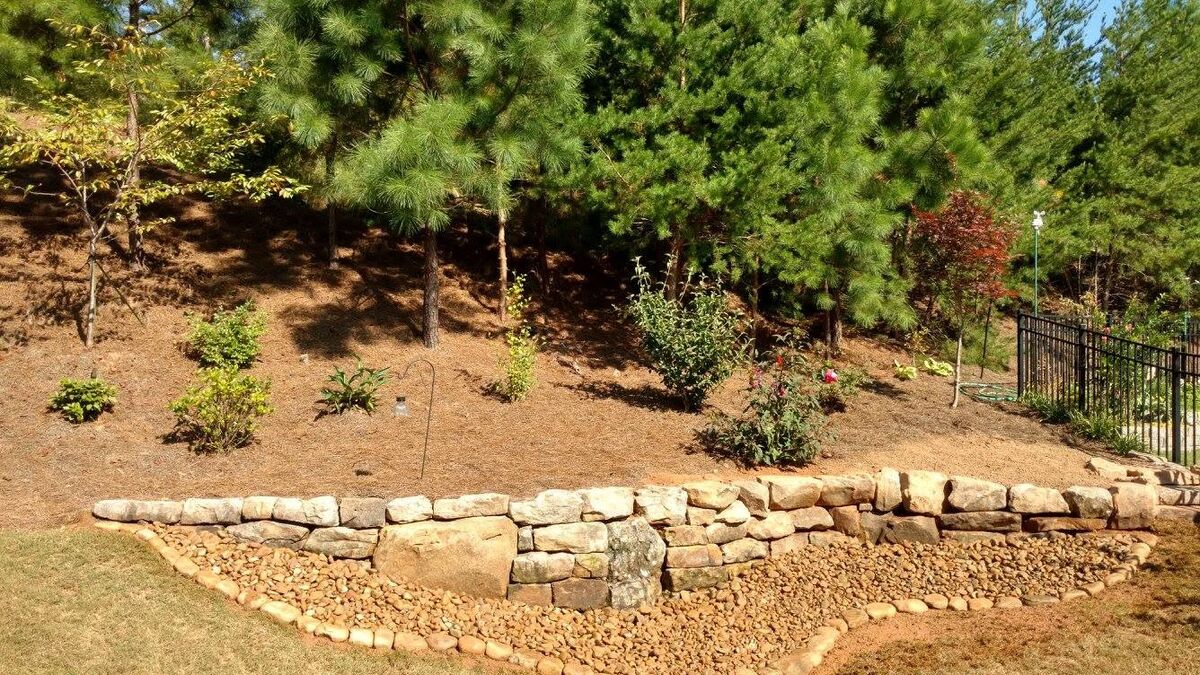
| Water running across the surface | A swale or a dry creek bed | A shallow channel catches the flow and steers it across the yard. Lining it with river rock keeps fast water from cutting into the soil. |
| Water collecting at one point | A catch basin | A grated box takes the water in at the low point and a solid pipe carries it away. |
| Water soaking through the soil | A French drain | A buried perforated pipe in clean stone collects water in the ground and carries it to an outlet. |
Plenty of yards need two of these working together. Whichever it is, the water has to end up somewhere that can take it, such as a lower part of your own lot. More on the two most common fixes: dry creek bed or French drain?
Water near the house
Water against a foundation is the one to deal with first. The ground should fall away from the house. The standard builders work to is a drop of at least 6 inches in the first 10 feet. Mulch and soil piled up over the years often flatten that slope or tip it back toward the wall.
Check the downspouts too. Roof water let out right at the foundation is a common cause.
What doesn’t work
- Mixing sand into clay. University of Georgia Extension says it plainly: adding sand to clay soil will not improve drainage. Its Bartow County office adds that sand or gravel in clay can leave layers that won’t drain properly.
- A drain with no outlet. A pipe that ends underground fills up and stops. Every drain needs a lower place to let the water out.
- Filling the low spot with soil. The water moves to the next low spot, which may be nearer the house.
More guides
- Creek bed or French drain?One moves water on the surface, the other collects it in the ground. How to tell which your yard needs.
- Plain-English glossaryBatter, course, crusher run, swale, surcharge and forty more trade words, explained in a sentence or two.
- Stone names and sizesFieldstone, flagstone, boulders, river rock and base stone: what the yard names mean and the sizes each comes in.